How EU tachograph infringements are classified
The European Commission classifies tachograph infringements into four severity categories under Directive 2006/22/EC and its annexes. The category determines the severity of the penalty and whether the vehicle can be immobilised at the roadside.
| Category | Abbreviation | Typical consequence |
|---|---|---|
| Minor infringement | MI | Warning or small fine |
| Serious infringement | SI | Fixed penalty fine |
| Very serious infringement | VSI | Higher fine; possible vehicle immobilisation |
| Most serious infringement | MSI | Immediate immobilisation; potential licence review |
The transport company (operator) is responsible for infringements by their drivers. Under Article 10 of Regulation (EC) No 561/2006, companies must ensure drivers comply, and companies can be fined even when the driver was at fault.
What are the fines for each infringement category?
Fine amounts are set nationally, so exact figures vary by member state, but typical ranges are consistent enough to plan around:
| Category | Typical fine range | What to do |
|---|---|---|
| Minor (MI) | €50 – €300 | Note and monitor. Unlikely to trigger authority action alone, but patterns of minor violations can be upgraded on re-inspection. |
| Serious (SI) | €300 – €1,500 | Record, communicate to the driver, and document corrective action for your internal compliance review. |
| Very Serious (VSI) | €1,500 – €5,000+ | Immediate corrective action. Document the circumstances and adjust the route/schedule that caused it. |
| Most Serious (MSI) | Highest bracket, often escalated | Treat as a licence-risk event: full documentation, driver debrief, and a written prevention plan. |
No immobilisation applies to Minor infringements; Very Serious and Most Serious infringements commonly result in the vehicle being immobilised at the roadside until the violation is remedied (e.g. the driver has taken adequate rest).
Daily driving time infringements
The EU daily driving limit is 9 hours, extendable to 10 hours twice per week.
| Violation | Category |
|---|---|
| Daily driving time exceeded by less than 1 hour | Minor (MI) |
| Daily driving time exceeded by 1 to 3 hours | Serious (SI) |
| Daily driving time exceeded by more than 3 hours | Very Serious (VSI) |
| Daily driving 10-hour extension used more than twice per week | Serious (SI) |
Weekly and fortnightly driving time infringements
The weekly driving limit is 56 hours. The total over two consecutive weeks must not exceed 90 hours.
| Violation | Category |
|---|---|
| Weekly limit exceeded by less than 2 hours | Minor (MI) |
| Weekly limit exceeded by 2 to 10 hours | Serious (SI) |
| Weekly limit exceeded by more than 10 hours | Very Serious (VSI) |
| Fortnightly (90-hour) limit exceeded by less than 4 hours | Minor (MI) |
| Fortnightly limit exceeded by 4 to 20 hours | Serious (SI) |
| Fortnightly limit exceeded by more than 20 hours | Very Serious (VSI) |
Break and rest infringements
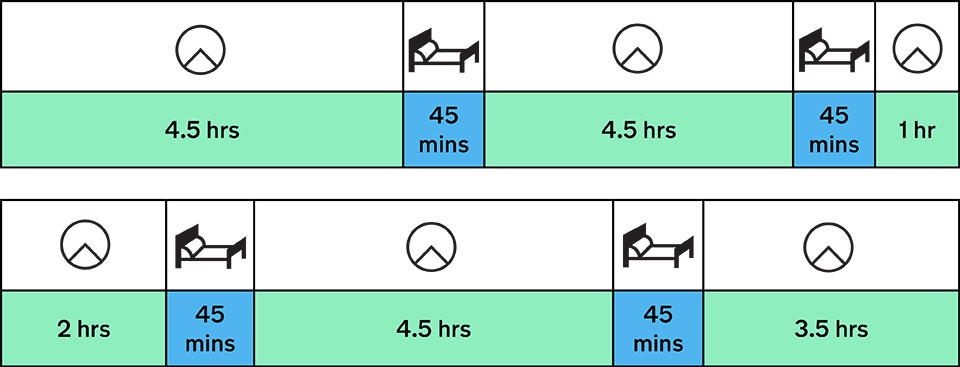
Drivers must take a 45-minute break after 4.5 hours of continuous driving. The break can be split into 15 minutes followed by 30 minutes.
| Violation | Category |
|---|---|
| Break time reduced by less than 15 minutes | Minor (MI) |
| Break time reduced by 15 to 30 minutes | Serious (SI) |
| Break time reduced by more than 30 minutes | Very Serious (VSI) |
| No break taken after 4.5 hours of driving | Very Serious (VSI) |
Daily rest:
The normal daily rest period is 11 hours. This can be reduced to 9 hours (reduced daily rest) up to three times per week, with the reduction compensated before the end of the following week.
| Violation | Category |
|---|---|
| Daily rest reduced by less than 1 hour | Minor (MI) |
| Daily rest reduced by 1 to 3 hours | Serious (SI) |
| Daily rest reduced by more than 3 hours | Very Serious (VSI) |
Weekly rest:
Drivers must take a regular weekly rest of at least 45 hours, or a reduced rest of at least 24 hours (with compensation within 3 weeks).
| Violation | Category |
|---|---|
| Weekly rest reduced by less than 3 hours | Serious (SI) |
| Weekly rest reduced by 3 to 9 hours | Very Serious (VSI) |
| Weekly rest reduced by more than 9 hours | Most Serious (MSI) |
| No weekly rest taken in two consecutive weeks | Most Serious (MSI) |
Tachograph use and card infringements
| Violation | Category |
|---|---|
| Tachograph not correctly used | Serious (SI) |
| Driver card not inserted when driving | Serious (SI) |
| Using another driver's card | Most Serious (MSI) |
| Tachograph data falsified or manipulated | Most Serious (MSI) |
| Damaged or malfunctioning tachograph not reported | Serious (SI) |
| Driving with a damaged tachograph for more than 7 days | Very Serious (VSI) |
Download obligation infringements
| Violation | Category |
|---|---|
| Driver card not downloaded within 28 days | Serious (SI) |
| Vehicle unit not downloaded within 90 days | Serious (SI) |
| Driver card download records not retained for 12 months | Serious (SI) |
Failure to download on time is consistently one of the most common infringements found during roadside inspections, and one of the most straightforward to avoid with compliance software.
What happens when an infringement is detected?
At a roadside inspection
Enforcement officers can stop commercial vehicles and conduct tachograph checks at any time.
If a Very Serious or Most Serious infringement is found, the officer may:
- Issue an immediate fixed penalty
- Require the driver to rest before continuing
- Immobilise the vehicle at the roadside
- Notify the transport company's licensing authority
If a Serious infringement is found, the officer will typically issue a fixed penalty notice and record the infringement on the operator's risk score.
Effect on operator licence
In the UK and across most EU countries, infringements are aggregated against the operator. A pattern of Serious or Very Serious infringements can trigger:
- A public inquiry by the Traffic Commissioner (UK)
- Suspension or revocation of the operator licence
- Financial standing requirements being increased
- Director disqualification in extreme cases
AI risk scoring
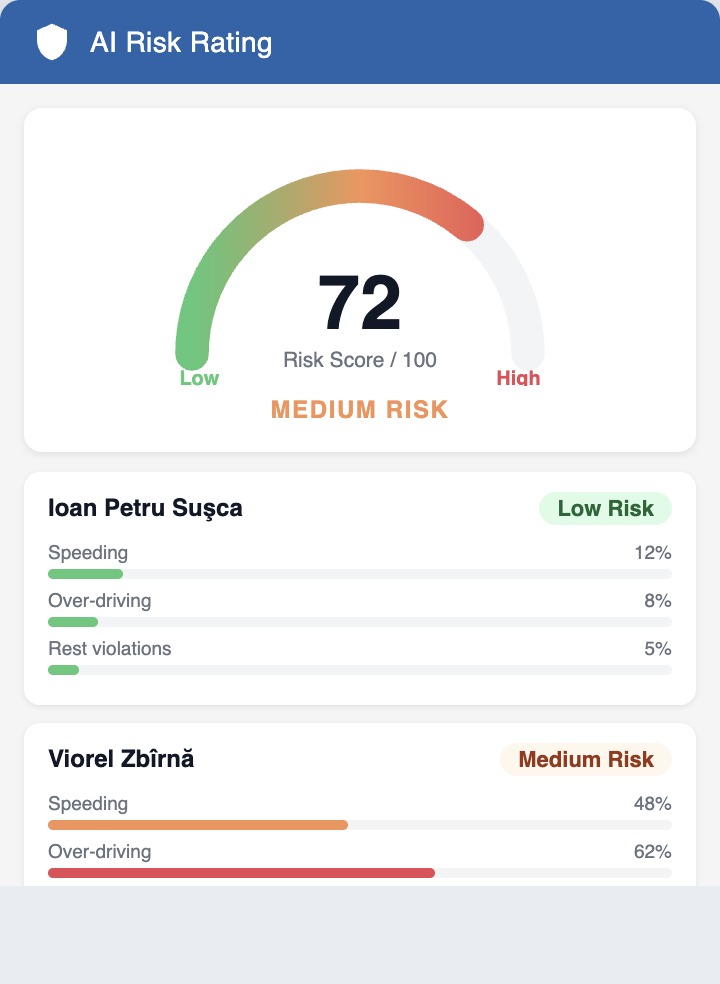
TachoCard's AI risk score for each driver is calculated from the number and severity of infringements detected in uploaded card data. In the Infringements report, each violation is shown with a colour-coded badge — red for Very Serious, orange for Serious, yellow for Minor — and weighted accordingly: Very Serious violations add 10 points to the risk score, Serious violations add 5 points, and Minor violations add 2 points. A driver with two Very Serious violations therefore scores noticeably higher than one with ten Minor violations, mirroring how enforcement authorities actually treat these categories. This lets a company prioritise by severity, not just volume, and address the highest-risk drivers before the next roadside inspection.
How to detect infringements automatically
Manual review of .ddd files is time-consuming and error-prone. Tachograph analysis software like TachoCard automatically:
- Parses the downloaded
.dddfile from the driver card - Applies EU Regulation 561/2006 and AETR rules to every recorded activity block
- Flags each infringement with its category (MI, SI, VSI, MSI) and the specific rule breached
- Generates a structured infringement report exportable as PDF or Excel
This means a transport manager can see every driver's infringement status after each upload, without manually reviewing any raw data.
Frequently asked questions
Can the same infringement appear on both the driver card and the vehicle unit?
Yes. Certain violations are recorded on both the driver card and the vehicle unit independently. Enforcement officers can cross-reference both records.
Does the infringement category differ by country?
The category system is defined at EU level by Directive 2006/22/EC and is harmonised across member states. However, fine amounts are set nationally.
What is the difference between a VSI and an MSI?
A Very Serious Infringement (VSI) typically results in a higher fine and possible vehicle immobilisation. A Most Serious Infringement (MSI) is reserved for deliberate violations and can result in immediate immobilisation and licensing escalation.
How far back can inspectors check tachograph data?
Driver cards store data for approximately 28 days of driving activity, and vehicle units store significantly longer histories. Companies must retain downloaded files for at least 12 months.
Are AETR rules the same as EU Regulation 561/2006?
They are broadly aligned but not identical. AETR applies to relevant international journeys involving non-EU AETR countries.
What is a minor infringement?
A minor infringement (MI) is a small deviation from a driving, break, or rest limit that has limited safety impact — for example, daily driving time exceeded by less than 1 hour, or daily rest reduced by less than 1 hour. It typically results in a warning or a small fine (around €50–€300) and does not lead to vehicle immobilisation, though a pattern of repeated minor infringements can be escalated at re-inspection.
Is a "Category 1 violation" the same as a Minor Infringement?
Some national schemes and fleet-audit frameworks (for example, earned-recognition or company-audit programmes) use their own numbered severity tiers, such as "Category 1" through "Category 4", which don't map one-to-one onto the EU's MI/SI/VSI/MSI scale. In most of these frameworks, "Category 1" is the lowest-severity tier and lines up closest to a Minor Infringement, while higher category numbers correspond to Serious, Very Serious, and Most Serious infringements. Always check the specific scheme's own definitions, since the exact thresholds vary by country and by audit programme.
Related articles
- The EU 28-day download rule explained
- How to download driver card data step by step
- Choosing the right tachograph card reader
Sources: Directive 2006/22/EC; EU Regulation (EC) No 561/2006; AETR Agreement 1970 (as amended).